


When AI Optimizes Applications and AI Screens Them Out: Who Still Recognizes the Right Talent?

There’s a moment that many Talent Acquisition teams are increasingly familiar with: you’ve equipped your screening process with AI, application volumes are higher than ever, shortlists arrive faster – and yet the quality of hiring decisions doesn’t feel any better. Sometimes it actually feels worse.
That’s not a coincidence. It’s the logical consequence of a system that has undermined itself.

The Dilemma: When AI Goes Up Against AI
Think of the selection process as a communication channel. On one side, candidates send a signal – an application meant to show who they are and what they can do. On the other side, companies receive that signal and try to draw conclusions about fit and potential. That channel is currently severely disrupted.
On the candidate side, AI writing tools are no longer a fringe phenomenon. Depending on role and seniority level, between 40 and 80 percent of applicants now use AI tools to write or optimize their resume for a specific position. SHRM has documented this phenomenon directly, describing it as an arms race that benefits neither employers nor candidates.
On the employer side, the response is understandable: AI-powered screening is supposed to make the flood of applications manageable. 43 percent of companies now use AI in resume screening, and the number is rising. The logic is simple: if we can’t read manually anymore, we let algorithms filter.
The problem lies in the simultaneity of both developments. When AI tools optimize application documents to contain specific keywords and phrases – and AI screening tools search for exactly those keywords and phrases – the system ultimately no longer measures candidate fit. It measures how well candidates’ AI tools predicted the company’s AI.
What This Means: Loss of Signal
The SHRM data is sobering on this point. Despite the sharp rise in AI adoption for screening, time-to-hire and cost-per-hire have both increased over the same period. 69 percent of organizations report that they still struggle to fill open positions – a figure that has barely changed since the AI screening wave began. Throughput was optimized. Outcomes were not.
The mechanics are structural: a resume is a marketing document created by the applicant for impression management. When AI tools now shape that document to hit screening criteria, AI screening no longer extracts information about actual fit – it extracts how well the candidate understood what the screening system rewards.
The result is what SHRM calls “Credentialing Theater”: both sides performing for the system rather than communicating with each other. Shortlists consist of people who produced excellent AI-generated applications, which is not, for most roles, the decisive competency.
There’s also an operational consequence many teams underestimate: when 400 out of 500 applications are optimized to pass the filter, AI screening no longer delivers a smaller, manageable longlist. It delivers a longer list of nearly identical profiles. According to a Robert Half study, 67 percent of HR leaders report that processing AI-generated applications has slowed down their hiring process.
The Silent Loser: The Right Candidates Are Being Lost
While teams are busy managing the flood of optimized applications, the candidates they actually want are available within a shrinking window. Current data shows that top candidates are off the market within 10 days on average. Screening processes that take two to three weeks don’t structurally fit that window.
The irony: candidates who didn’t submit AI-optimized materials – sometimes the most direct communicators – are more likely to be filtered out by keyword matching because their phrasing deviates from the norm. The system discriminates against authenticity.
What Are the New Selection Signals?
When text-based signals lose their ability to differentiate in a world of ubiquitous AI writing tools, the critical question becomes: what can’t be mass-produced with AI? The answer requires a process adjustment: anything that demands real-time communication, context-specific thinking, and genuine motivation.
Async video screens have become the first step in screening for a growing number of teams. Candidates answer role-specific questions on video, in their own words, without preparation from an AI writing tool. What becomes visible: how someone communicates, whether their thinking is clear, and whether their motivation for the company and role comes across as authentic.
Skill-based assessments with situational scenarios that require real contextual knowledge are increasingly replacing generic competency questions. When the scenario is specific enough, even the best AI doesn’t help – because answering correctly requires genuine knowledge of the specific context.
Structured first interviews with behavioral questions can also differentiate – when probed deliberately. AI can write a generic text. It can’t simulate personal experience when you ask about the specific context, the candidate’s own role, and the lessons they drew from it.
How Processes Need to Be Recalibrated
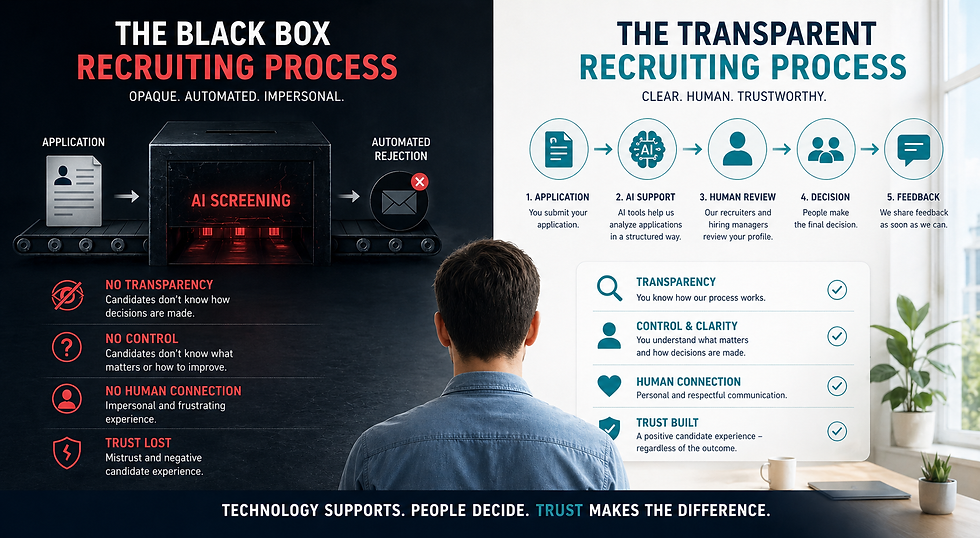
This is not an invitation to general distrust of AI in recruiting. AI remains valuable – for sourcing, scheduling, transcription, and summarization. The problem is specific: using AI to evaluate documents that candidates created with AI produces circular results.
The consequence is a clear separation: automation belongs in process logistics; human judgment belongs in evaluation.
First: don’t treat the resume screen as the sole selection instrument. Text-based materials can still provide clues – but they should be complemented by an additional, non-text-based step before real selection decisions are made.
Second: design screening questions so they can’t be answered generically. “What excites you about this role?” any AI can answer easily. “What do you know about the specific challenges of this role in our context, and how would you approach them?” significantly less so.
Third: take process speed seriously. As long as more than seven to ten days pass between application receipt and first contact, you are systematically losing the most sought-after candidates.
Fourth: ask which signals in your own selection process are actually still valid. That’s an uncomfortable but necessary question. When a selection signal can be constructed with minimal effort, it has lost its predictive power.
What Does This Mean for TA Teams?
The arms race between AI-optimized applications and AI-powered screening is not a temporary phase. It’s the new normal. And it’s intensifying, because both sides keep improving their tools.
TA teams that start aligning their processes around valid signals now – rather than chasing better text matching – will develop a structural advantage. Not because AI in recruiting is useless, but because using AI to evaluate AI-generated outputs doesn’t produce selection decisions. Only selection illusions.
The real question is no longer: should we use AI in screening? The question is: which signals still differentiate in a world where AI can produce text on demand – and how do we build processes that surface exactly those signals?
Sources
Transparency Notice on the Use of AI
Artificial intelligence tools were used in a supporting role in the preparation of this article. They are primarily used for research and information structuring, linguistic and grammatical review, translation, and, in some cases, the creation or editing of illustrations and visual content.
The concept, substantive statements, assessments and conclusions are those of the author and reflect his personal views, professional experience and convictions. All content is reviewed editorially before publication and remains under the author’s responsibility.
Articles on this website are neither created nor published automatically by AI. Artificial intelligence is used as a supporting tool only; full editorial and substantive responsibility remains with the author.


Comments