


Bias Audit in Recruiting – Exposing Systemic Bias Before Regulation or Reputation Does


Recruiting is often seen as an objective process. Résumés are reviewed, interviews conducted, and decisions documented. Many organizations, therefore, assume that bias—systematic distortion in decision-making—is primarily an individual issue: an unconscious impression in an interview or a gut feeling during selection.
The reality is less comfortable. Bias does not arise solely in individuals' minds. It is often embedded in the system itself. Job profiles evolve over time, sourcing channels reach certain groups more than others, interview processes vary widely in structure, and, increasingly, another layer enters the equation: algorithmic decision support.
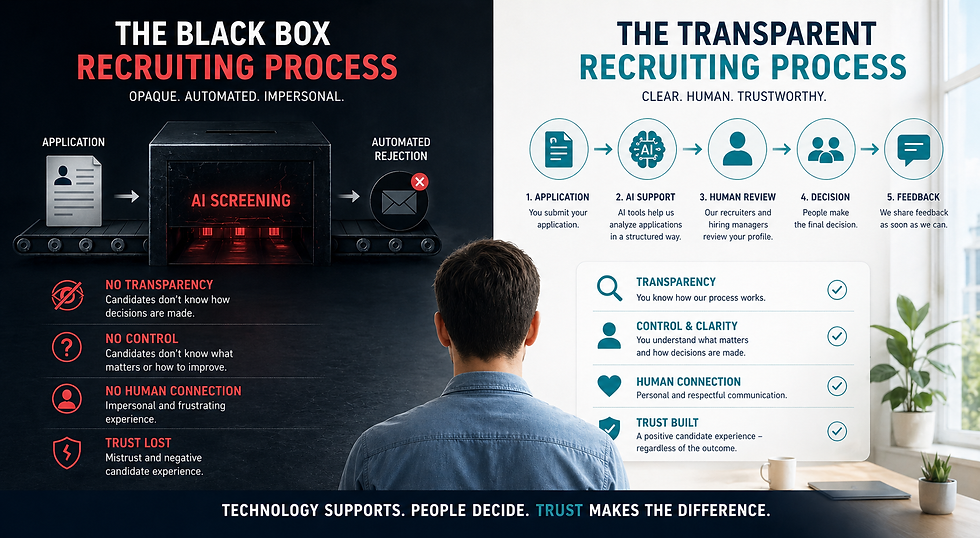
The problem is not the technology itself. The problem is that artificial intelligence reproduces existing patterns—and therefore existing biases. If historical data is skewed, algorithms will statistically stabilize and amplify those distortions. At that point, bias stops being merely a cultural issue and becomes a governance issue.
This is precisely where regulation begins to intervene. Under the EU AI Act, many recruiting systems that automate or strongly influence candidate evaluation are classified as high-risk AI systems. This classification introduces concrete obligations: risk analysis, data governance, monitoring, and systematic bias checks.
For Talent Acquisition teams, this creates a new reality. Bias audits will increasingly be conducted not only because of diversity commitments but also because of regulatory necessity.
The good news: a meaningful bias audit is not an academic exercise. Many distortions can be identified through a structured process review—without launching a six-figure consulting project.
Why Bias in Recruiting Is Almost Always a System Problem
Most organizations respond to bias with training: unconscious bias workshops, interview training, or awareness initiatives. These measures are useful. However, they address only part of the problem.
Bias often emerges much earlier in the process—long before any interview takes place.
For example, if a company recruits mainly through specific job platforms, it automatically reaches a certain candidate population. Similarly, if job profiles are strongly designed around linear career paths, career switchers may be systematically excluded.
Recruiting processes have multiple structural filters that may appear harmless individually but, together, can create significant distortions.
Typical structural sources of bias in recruiting include:
Historical job profiles are implicitly designed around specific career paths.
Sourcing channels that overrepresent certain demographic groups
Automated CV-screening systems trained on historical data
Unstructured interviews with highly variable evaluation logic
Hiring manager decisions without defined selection criteria
Evaluation forms that emphasize “culture fit” over competencies
Research by Gartner on Diversity, Equity, and Inclusion (DEI) in Talent Acquisition repeatedly highlights this pattern: bias rarely emerges from a single decision. Instead, it results from process chain effects. This is exactly where the bias audit comes in.
When Bias Audits Become Legally Relevant
With the European regulation of artificial intelligence, the issue becomes significantly more concrete. The EU AI Act classifies certain HR technologies as high-risk systems—particularly those that automate or strongly influence hiring decisions or candidate assessments.
Articles 9 and 10 of the regulation define clear requirements:
Implementation of a risk-management system
Ensuring high-quality and representative datasets
Monitoring potential discriminatory outcomes
Documentation of decision logic
In practice, this means organizations must be able to demonstrate that their systems do not produce systematic discrimination.
In addition to European regulation, national anti-discrimination laws already apply. In Germany, the General Equal Treatment Act (AGG) is central; in Switzerland, similar principles exist in equality legislation and labor law.
For Talent Acquisition teams, this raises two critical questions:
Where could systematic bias arise within our recruiting process?
How can we demonstrate that these risks are actively monitored?
A bias audit provides exactly this transparency.
The Pragmatic Bias Audit for TA Teams
The term “audit” often conjures up images of external consultants, statistical models, and legal reviews. In reality, many relevant questions can be addressed internally.
A pragmatic bias audit typically focuses on three perspectives:
Process analysis
Data analysis
Decision analysis
The objective is not perfection—but transparency.
1. Process Analysis – Where Structural Bias Can Emerge
The first step is surprisingly simple: map the entire recruiting process. Many organizations discover their first distortions already at this stage.
Typical process-audit questions include:
Where exactly do automated pre-selections occur?
Which criteria lead to candidate exclusion?
What role do tools and algorithms play in screening?
How strongly do interviews vary between teams or hiring managers?
Who makes final decisions—and on what basis?
Important areas of analysis include:
Job descriptions and requirement definitions
Sourcing channels
CV-screening mechanisms
Interview structure
Evaluation models
Decision logic within hiring panels
Even this level of transparency can significantly reduce the risk of bias
.
2. Data Analysis – Where Statistical Differences Become Visible
The second step is data-driven. Many Applicant Tracking Systems (ATS) already contain enough information to reveal potential distortions.
Typical analytical questions include:
How do conversion rates differ between candidate groups?
Which groups drop out of the funnel earliest?
Which sourcing channels lead to which candidate profiles?
Are there differences in interview evaluations?
Relevant metrics may include:
Application → interview conversion
Interview → offer conversion
Offer acceptance rates by candidate group.
Funnel drop-off by recruiting stage
Differences between hiring managers
A bias audit is not about assigning blame. It is about identifying patterns. When certain groups consistently drop out earlier in the funnel, the process design deserves closer scrutiny.
3. Decision Analysis – How Hiring Decisions Actually Occur
The third step examines the mechanics of decision-making. Many hiring decisions appear structured on the surface. In practice, however, criteria are often implicit.
Typical audit questions include:
Is a structured interview scorecard in place?
Are candidates evaluated against the same criteria?
How strongly do interviewer ratings vary?
Are hiring decisions documented?
Research from SHRM indicates that structured interviews are among the most effective tools for reducing bias. When interviewers apply inconsistent criteria, decision variance increases—and with it, the risk of bias.
A Simple Bias Audit Checklist for TA Teams
A pragmatic audit can begin with a straightforward checklist.
Process Structure
Are standardized job profiles with clear competency requirements in place?
Are sourcing channels diversified or heavily concentrated?
Are automated screening tools used?
Are structured interview guides available?
Are evaluation decisions documented?
Data Foundation
Are funnel data systematically analyzed?
Are differences between candidate groups identified?
Are these differences reviewed regularly?
Are algorithms periodically evaluated?
Decision Logic
Are structured scorecards used in interviews?
Are interview evaluations calibrated across interviewers?
Are hiring decisions documented with clear reasoning?
Are recruiters and hiring managers regularly trained?
These questions may seem simple. That is precisely why they are effective. Many bias risks arise not from complex technology, but from missing structure.
Bias Audits as an Opportunity for Talent Acquisition
A common assumption in recruiting is that bias audits are primarily compliance work. That view is too narrow. Organizations that systematically analyze their recruiting processes usually gain more than regulatory safety.
Typical side effects of bias audits include:
Clearer job profiles
More structured interviews
Greater consistency in hiring decisions
Improved recruiting data quality
Increased transparency for candidates
In many cases, a bias audit improves not only fairness but also quality of hire. The reason is straightforward: structured processes typically produce better decisions.
The Strategic Context: AI Makes Recruiting Measurable
The most important reason for bias audits lies in a broader transformation.
Recruiting is increasingly supported by technology. CV screening, interview analytics, candidate matching—more and more decisions are prepared or influenced by systems.
As a result, expectations toward Talent Acquisition are changing. Recruiting used to be largely an experience-driven discipline. Today, it is becoming a governance discipline.
TA leaders must increasingly answer questions such as:
How do our selection mechanisms work?
What data foundation do they rely on?
How do we prevent systematic bias?
The bias audit is therefore not a one-time project. It becomes part of recruiting governance—and that is precisely where its strategic importance lies.
Sources
EU Artificial Intelligence Act – Articles 9 and 10
ClearCompany Talent Acquisition Trends Report 2026
SHRM – Diversity & Inclusion Hiring Research
Gartner – Diversity, Equity & Inclusion in Talent Acquisition Research (2025)
European Commission – Definition of High-Risk AI Systems


Comments