


When the Resumé Enters the Black Box – Candidate Trust in the AI Era

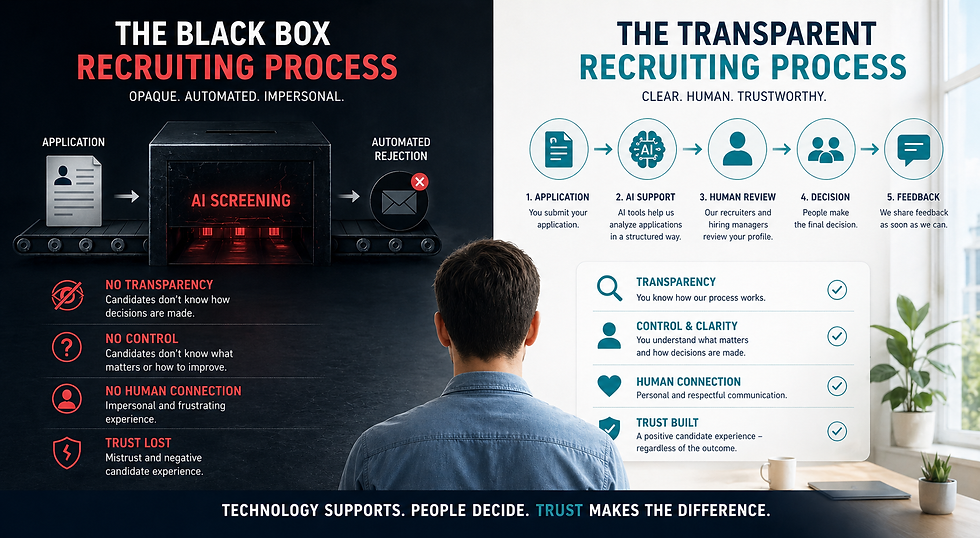
Recruiting is currently undergoing profound changes. Artificial Intelligence (AI) is no longer just an experiment in innovation labs. In many organisations, it has become part of the operational recruiting process: résumés are automatically screened, interview transcripts analysed, and candidate communication partially automated.
However, the adoption of AI is only part of the story. The main argument of this text is that, in recruiting, the greatest challenge today is not the use of new technologies themselves, but the trust candidates place in them.
Candidates increasingly know that these technologies exist. And they react to them.
The key shift in 2026 is therefore not the technology itself, but candidate trust. Many applicants now assume that their application will first be evaluated by a machine. This expectation influences behaviour. Candidates optimise their résumés for algorithms, use AI tools to rewrite profiles, or withdraw from processes they perceive as opaque.
Recruiting has entered a new trust economy, where organisations must clearly explain their use of AI.
This is where the EU AI Act becomes relevant. Article 13 requires transparency about the use of AI systems. In recruiting, this means candidates must understand that AI is being used, where it is used, and what role it plays in the decision-making process.
Many organisations underestimate how strongly this transparency question already affects the candidate experience.
Why Candidates Increasingly Distrust AI
Distrust toward automated decisions is not hypothetical. Research shows that trust in institutions, organisations, and technology has been under pressure for years.
The Edelman Trust Barometer 2025 highlights growing scepticism toward automated decision-making, particularly when it affects careers or income. At the same time, the SHRM Candidate Experience Survey shows that transparency about the hiring process is one of the most important drivers of a positive candidate experience.
Together, these developments create a new reality in recruiting: candidates accept AI – but only when they understand how it is used.
Typical reactions from candidates in 2026 include:
Algorithm optimisation of résumés
Applicants use AI tools to tailor their CVs to specific job descriptions.
Keyword strategies
Many candidates assume that Applicant Tracking Systems (ATS) primarily filter for keywords.
Scepticism toward automated rejections
Standardised rejection messages without context are often interpreted as algorithmic decisions.
Distrust toward video interview tools
Especially tools that claim to analyse personality or emotions face growing scepticism.
Withdrawal from the application process
When candidates feel their application disappears into a “black box”.
For Talent Acquisition teams, this creates a paradox: technologies designed to increase efficiency can undermine the perceived fairness and transparency of hiring processes if they are not properly explained.
What the EU AI Act Actually Requires
The EU AI Act represents the first comprehensive regulatory framework for artificial intelligence worldwide. Recruiting technologies are often classified as high-risk AI systems because they directly affect professional opportunities. Article 13 defines transparency requirements.
At its core, the regulation focuses on explainability and traceability. Organisations must ensure that users – in this case, candidates – can understand:
that an AI system is being used
What role does the system play in the decision-making process?
What data is being processed
Which factors influence decisions
One important misconception should be clarified.
The AI Act does not require organisations to disclose their entire algorithm. However, they must be able to explain in understandable terms how decisions are supported or influenced by AI.
For recruiting, this represents a significant shift in communication. The previous default approach – not mentioning AI at all – will increasingly become problematic from both a regulatory and reputational perspective.
The Real Problem: Communication Gaps in Recruiting
Many Talent Acquisition (TA) teams invest significant effort in selecting technology, implementing Applicant Tracking Systems (ATS), and optimizing recruiting workflows.
Communication with candidates, however, is often overlooked.
This creates a surprising situation: the organisation uses AI, but nobody explains it.
As a result, candidates tend to assume that the technology is far more powerful than it actually is.
A common real-world example illustrates this. An organisation may use AI simply to prioritise applications based on predefined criteria. The final decision is still made by recruiters and hiring managers. If this is not communicated clearly, candidates may interpret the process differently: “My résumé was probably filtered out automatically.”
This results in a trust issue. Technology does not create distrust. A lack of explanation does.
A Simple Communication Framework for Recruiting AI
Transparency does not need to be complex. In practice, a clear communication concept along the key candidate touchpoints is usually sufficient.
Three points are particularly relevant:
job advertisements
application confirmations
rejection messages
When AI usage is explained at these points, candidates perceive the hiring process very differently.
1. Transparency in Job Advertisements
The job advertisement is often the first point of contact between candidates and an organisation. This is where transparency should begin. A short paragraph is usually enough.
Key elements include:
a reference to the use of recruiting technology
An explanation of the role AI plays in the process
clarification that human decision-makers remain involved
Example:
“We use digital tools to support the structured review of applications. Final hiring decisions are always made by our recruiters and hiring managers.”
This sentence may seem simple. But it prevents the perception of a black-box recruiting process.
2. Transparency in Application Confirmations
Application confirmations are an underestimated communication channel. Every candidate receives them. This makes them an ideal place to briefly explain the process.
Helpful elements include:
a short overview of the next steps
a note about technological support
a realistic timeline
Example structure:
confirmation of application receipt
Explanation of the review process
information about next steps
Example text:
“Your application is currently being reviewed by our recruiting team. To support this process, we use digital tools that help structure and organise applications. Final evaluations are conducted by our recruiters and the responsible hiring manager.”
The effect is straightforward. Technology is integrated into a human-led process.
3. Transparency in Rejections
Rejections are one of the most sensitive points in the hiring process. Completely generic rejection messages can easily create negative interpretations. Transparency can help maintain trust even in these moments.
Possible elements include:
reference to the review process
Explanation of the decision context
respectful and appreciative wording
Example:
“After carefully reviewing your application, we have decided to continue with candidates whose profiles currently align more closely with the requirements of the role.”
Important considerations include:
avoiding language that sounds automated
avoiding phrases that implicitly shift responsibility to “the system.”
Rejections should always communicate that people make the final decisions.
The Strategic Perspective: Trust as a Competitive Advantage
Many organisations treat AI transparency primarily as a compliance requirement. That perspective is too narrow. In reality, transparency is also an employer branding issue.
Candidates increasingly compare hiring processes. Organisations that openly explain how they use technology are often perceived as more modern, fair, and trustworthy.
Transparent AI communication can therefore lead to:
Higher perceived fairness in the recruiting process
lower scepticism toward automation
stronger credibility of the employer brand
The key difference is not just technology. It is how organisations talk about it.
What Talent Acquisition Teams Should Do Now
Most organisations do not need entirely new processes. Often, it is enough to adapt existing communication.
A pragmatic starting point might include:
Analysing recruiting processes for AI touchpoints
Reviewing the candidate journey for transparency gaps
defining standard explanations for AI usage
training recruiters to answer AI-related questions
aligning communication with legal and compliance teams
One point is particularly important. Recruiters – and ideally all members of the hiring team – should always be able to explain how AI is used in their recruiting process If recruiters themselves are uncertain, that uncertainty will inevitably be transferred to candidates.
The Real Challenge Is Not Technology – It Is Trust
Discussions about AI in recruiting often focus on technology. Which tools are better? Which models are more precise? Which automations are more efficient? For candidates, this perspective is secondary. Their core question is much simpler: “Will my application be evaluated fairly?”
The EU AI Act forces organisations to answer this question more systematically. Article 13 makes transparency a regulatory obligation. For Talent Acquisition teams, however, this is also an opportunity.
Organisations that clearly explain AI respect candidates and show technology supports—not replaces—human judgment. In the labor market where hiring processes are becoming increasingly digital, this may become a decisive differentiator:
The most trusted recruiting processes will not necessarily be those with the most advanced AI. They will be those who use it most transparently.
Sources
Edelman Trust Barometer 2025
EU Artificial Intelligence Act – Article 13 (Transparency and Provision of Information)
SHRM Candidate Experience Survey
Matchr Talent Acquisition Trends 2026



Comments