


Candidate Experience 2026: What Job Seekers Really Want – and Where Companies Still Fall Short


Only 26 percent of job seekers in North America describe their most recent application experience as truly good. The rest struggled through, were ignored, dropped out, or walked away with a different impression – not of the role, but of the company behind it.
That number should be a wake-up call. Instead, it's part of a pattern that has barely changed in years: candidate experience is considered important in most TA strategies (over 90 percent of recruiting leaders say so), yet the actual processes don't follow that conviction. That's the real gap – not the one between expectation and delivery, but the one between belief and action.
The Criteria Corp 2026 Candidate Experience Report, based on surveys with more than 2,500 job seekers worldwide, offers a sobering picture. Combined with labor market data from the DACH region and current developments around AI, pay transparency, and the evolving role of the resume, a clear direction emerges – for teams that want to be in a different position by 2027.
The First Filter Is at the Top: Salary Transparency
Candidates make their decision long before they click "Apply." The first moment a candidate experiences a company is the job posting itself. And that's already where the first failure happens.
83 percent of job seekers name compensation as the single most important factor when evaluating a role. 72 percent say they're less likely to apply when no salary range is listed. 79 percent say missing pay information makes them question a company's transparency.
This isn't a Germany-specific phenomenon, but in the DACH region a structural factor makes it worse: the DIHK Skilled Labour Report 2025/2026 shows that more than a third of German companies cannot fill vacancies – while at the same time 39 percent of young applicants drop a process when compensation isn't communicated transparently. A company complaining about a talent shortage while refusing to publish a salary range is sabotaging itself.
Pay transparency isn't a nice-to-have. It's the first test of whether a company passes or fails in the application process.

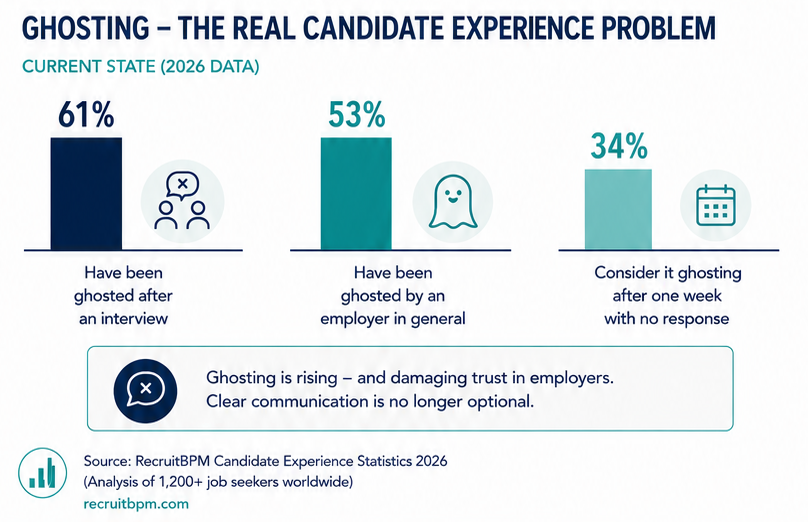
Ghosting: From 38 to 53 Percent – a Trust Problem Escalating
In 2024, one in three job seekers reported being left without a response by a company during an active process. By 2026, it's one in two: 53 percent say they were ghosted by an employer in the past year. 61 percent of those – after a completed interview.
The increase is not a coincidence. Criteria Corp attributes much of it to the exponential growth in application volume driven by AI tools: when teams can no longer manually follow up with everyone, silent rejection becomes a coping mechanism. What feels understandable from a capacity standpoint is an expensive problem from a brand perspective.
83 percent of candidates want to know as soon as possible when they're out of the running. 70 percent would view a rejection with a clear reason positively – not as offensive, but as respectful communication. What frustrates candidates is rarely the rejection itself. It's the silence that follows.
The operational consequences are measurable: top employers who update candidates on their status within three to five days achieve significantly higher Candidate Net Promoter Scores than average. 47 percent of applicants say they would withdraw from a process solely due to poor communication – regardless of how attractive the role is.
Ghosting isn't just a candidate experience problem. It's an employer brand problem with direct costs.
Application Processes: Complexity Nobody Asked For
60 percent of job seekers have abandoned an application at some point – not because they didn't want the job, but because the process was too long or too complex. Form fields asking for the same information twice, mandatory fields with no clear purpose, missing mobile optimization: these aren't small friction points. They're selection mechanisms – but they select for patience, not fit.
41 percent of students and young graduates in Germany drop a process when they don't feel a personal connection with the recruiter. That sounds soft, but it has a hard implication: communication and human warmth in the process aren't a soft factor – they're a conversion factor.
Companies looking to increase their applicant completion rates shouldn't optimize their job postings first. They should look at what percentage of started applications are actually finished.
AI in the Process: Accepted – But Under Clear Conditions
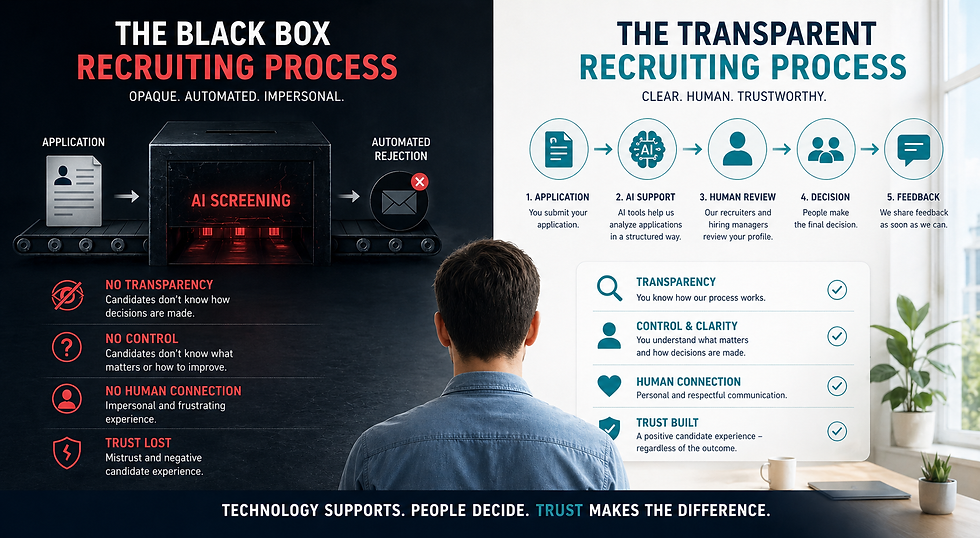
Candidates have made their peace with AI in recruiting. 67 percent accept AI-assisted screening in principle – as long as a human makes the final call. 79 percent actively expect transparency about when and how AI is being used in the process.
The problem isn't the AI itself – it's how it's communicated. 41 percent of respondents say they would be less likely to apply, or would avoid applying altogether, if a company openly stated that AI is used for screening.
That sounds contradictory, but it isn't: the difference lies in how AI is framed. Teams at companies like Arup and Accenture report that candidates respond positively to automation when it's communicated as an invitation to a conversation – not as a filter that sorts people out.
Accenture processes over five million applications annually. The solution wasn't to reduce human interaction – it was to concentrate it on the moments that matter and let technology handle everything else. The result: the peak of the experience for candidates is still the moment they meet real people.
AI makes processes more efficient. But it doesn't replace what candidates remember most.

The Resume Is Losing Its Monopoly
One signal from the Criteria Corp report deserves particular attention because it signals a structural shift: 68 percent of job seekers are open to replacing the resume as the central application document – or dropping it entirely.
70 percent customize their resume for each position – many of them using AI.
This is the logical consequence of a growing dilemma: when all documents look the same, the document itself no longer differentiates. What differentiates is what's behind the document.
34 percent of applicants have already actively used AI for their application materials. Skills-based profiles, asynchronous video screens, and situational tasks are growing as alternatives. Companies that continue to rely exclusively on the resume as their first selection step will increasingly be choosing from a pre-optimized document pool – not from the actual talent pool.
What This Means: Three Principles for 2026 and Beyond
First: Candidate experience is employer brand – at every touchpoint.
Every email, every silence, every rejection is a brand interaction. Organizations that consistently act on this report self-reinforcing talent pipelines fueled by referrals and reapplications. Those that don't lose that effect – and usually only notice when their employer ratings start to slip.
Second: Speed is quality.
Top candidates are off the market in an average of ten days. Processes that take two to three weeks to make first contact systematically lose the candidates with the highest market demand. Faster disposition isn't a shortcut – it's a baseline requirement to keep pace with the market.
Third: Human moments need to be deliberately created.
In a world where AI takes over more and more routine steps, the human moment becomes more valuable – not less. Teams that consistently use AI for logistics, scheduling, communication templates, and initial screening free up time for what candidates actually remember: real conversations, honest feedback, personal connection.
Where This Is Heading
The outlook for 2027 is clear: AI will take over more parts of the process – including autonomously conducted initial screenings. At the same time, candidate expectations around transparency, dignity, and speed are growing. The competition for talent is increasingly playing out not on the platform, but in the experience.
Companies that invest now in the quality of every touchpoint – starting with the salary range in the job posting and ending with the final feedback after a rejection – are building a structural advantage. Not because it sounds appealing, but because the data backs it up: 26 percent with a great experience is the benchmark to beat. The gap between those who do it and those who wait is widening.
The defining question for TA teams is no longer: do we prioritize candidate experience? It's: which touchpoint are we fixing first?


Comments