


Anyone Can Onboard People — But How Do You Onboard an AI Agent?


Every recruiting team has an onboarding process for new hires: a job description, clear responsibilities, a point of contact, a probation period with feedback conversations. But the moment that same team introduces an AI tool for sourcing, screening, or scheduling, all of that instinct disappears. The agent gets switched on, given access to the ATS – and just runs. No job profile, no clear boundaries, no first feedback conversation.
That's exactly where an analysis by Joseph Fuller, a professor at Harvard Business School, comes in – published in the Harvard Business Review. His argument: the real bottleneck in adopting agentic AI isn't the technology; it's how work is organized.
Companies only get real value out of AI agents once they start managing them like colleagues – with a defined role, clear boundaries of authority, and accountability. For recruiting teams currently rolling out AI-powered workflows, this is more than an academic observation. It's a blueprint for turning a tool you just switched on into a team member you can actually trust.
Switching On Instead of Onboarding
Most AI rollouts in recruiting follow the same pattern: a tool gets evaluated, approved, deployed – and then it just keeps running. There's rarely a phase where anyone asks: What exactly is this agent responsible for? Where does its decision-making authority end? Who's actually checking its output in the first few weeks?
That missing structure backfires in two ways. First, it creates uncertainty on the team: recruiters don't know exactly what they can rely on the agent for and what they can't, which breeds distrust and, in the worst case, outright rejection of the tool. Second, the real value gets lost. A sourcing agent that just "runs alongside" the team, instead of owning a clearly defined task, will rarely outperform a slightly better search filter.
The Core Idea: Treat AI Agents Like New Hires
Fuller's central proposal translates directly into established HR practice. Every AI agent should get something like a job description, just like a new colleague would: What is it responsible for, where does its decision-making authority end, and when does it need to bring in a human? On top of that comes a clearly defined set of sources the agent is allowed to draw on – its equivalent of onboarding materials and institutional knowledge – plus escalation rules for anything that falls outside its remit.
Translated to a recruiting team, that means: a sourcing agent doesn't get an open-ended mandate to "find the best candidates." Instead, it gets a precise task – for example, building a longlist based on defined must-have and nice-to-have criteria, with the clear rule that no LinkedIn outreach goes out without team sign-off.
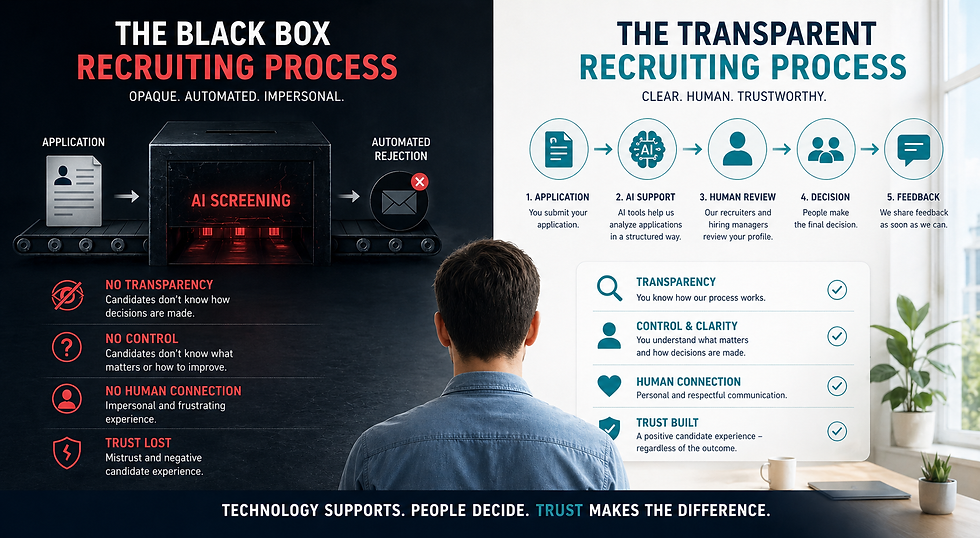
A screening agent may filter out clearly unqualified applications, but it may not send final rejections without a second opinion from a human. These boundaries aren't a vote of no confidence in the technology – they're exactly what a good job description does: create clarity about what's expected, both for the agent itself and for the team working alongside it.

Feedback Loops Instead of Set-and-Forget
New hires get regular feedback in their first few months, often through a structured probation review. With AI agents, that reflex is almost always missing – even though it matters just as much here. An onboarding plan for AI agents should therefore include fixed evaluation checkpoints: after the first two weeks, after the first month, and at regular intervals after that.
For a TA team, that means concretely: spot-checking the agent's shortlists against the judgment of experienced recruiters. Tracking how often and why the agent escalated – too often points to boundaries that are too tight, too rarely points to a blind-spot risk. And explicitly asking where the agent is saving time day to day and where it's creating extra rework. This evaluation isn't a one-time launch check – it should become as routine as good people development: recurring, documented, with clear next steps.
The Compliance Window Is Closing
This structured approach is becoming more than a best-practice tip this summer – it's increasingly a requirement. The EU AI Act's high-risk obligations for AI systems used in employment contexts – which explicitly include systems for candidate selection and evaluation – take effect on August 2, 2026. Anyone who hasn't established a traceable framework for role, decision boundaries, and human oversight of their AI agents by then will struggle to credibly produce the documentation and risk assessment regulators will expect after the fact. A clean onboarding process for AI agents isn't just good team leadership – it's also the foundation for the compliance record authorities will increasingly demand.
What TA Teams Should Do
The most practical starting point is to treat the next AI agent you introduce exactly like a new hire. Before go-live, write a short job description: task, decision-making authority, escalation cases, approved data sources. Name one person on the team who explicitly checks the agent's output during the first few weeks – the same way a buddy or manager would for a new colleague. And schedule a fixed date for that first "probation review" from day one, rather than letting the tool run until something goes wrong.
That sounds like extra work – and it is. But it's exactly the work that turns an experimental tool into a team member you can rely on. Almost every company knows how to onboard people well by now. The question that will determine the real payoff of AI in recruiting in 2026 is whether teams are willing to bring the same level of care to onboarding their AI agents.

Sources
Joseph Fuller: "Create an Onboarding Plan for AI Agents", Harvard Business Review, March 25, 2026.
"Agentic AI HR Team Playbook: Recruiting + Onboarding 2026", digitalapplied.com (context on EU AI Act high-risk obligations for employment AI starting August 2026).
Transparency Notice on the Use of AI
Artificial intelligence tools were used in a supporting role in the preparation of this article. They are primarily used for research and information structuring, linguistic and grammatical review, translation, and, in some cases, the creation or editing of illustrations and visual content.
The concept, substantive statements, assessments, and conclusions are those of the author and reflect his personal views, professional experience, and convictions. All content is reviewed editorially before publication and remains under the author’s responsibility.
Articles on this website are neither created nor published automatically by AI. Artificial intelligence is used as a supporting tool only; full editorial and substantive responsibility remains with the author.


Comments