


Recruiting Automation: What Should Actually Be Automated — and What Shouldn't


Recruiting automation is no longer a vision of the future. Adoption has grown from 26 to 43 percent of all HR functions in a single year — and Gartner predicts that by 2027, around 81 percent of all recruiting functions will be using AI-powered tools. The pressure is real: organizations that don't automate lose time, money, and competitive advantage.
And yet the critical question isn't whether to automate. It's where.
Many teams are automating the wrong things. They save time when speed helps the process, while ignoring the fact that the very moments that determine candidate experience and employer brand are increasingly running on autopilot. That's not a technical problem. It's a strategic one.
Why Automation in Recruiting Makes Sense
The numbers are clear. Organizations using AI-powered recruiting tools report 31 percent faster time-to-fill rates and a 50 percent improvement in hiring quality. Using an ATS saves an average of $7,000 per hire through lower advertising costs, less manual work, and shorter processes.
In the Anglo-American market, chatbots now handle 67 percent of all initial candidate inquiries without human intervention, improving response times by 89 percent. 73 percent of companies use chatbots for initial candidate pre-screening, 68 percent for answering FAQs. And 75 percent of candidates report positive interactions with well-implemented AI chatbots.
The potential is there — including for those of us in DACH. The question is how to use it without damaging what recruiting is actually about: winning people.
Automate — or Not?
A simple decision framework operates on two axes: the value of the task to the process (high vs. low) and whether human proximity or judgment is essential (yes vs. no).
High process value, low need for human proximity → Automate
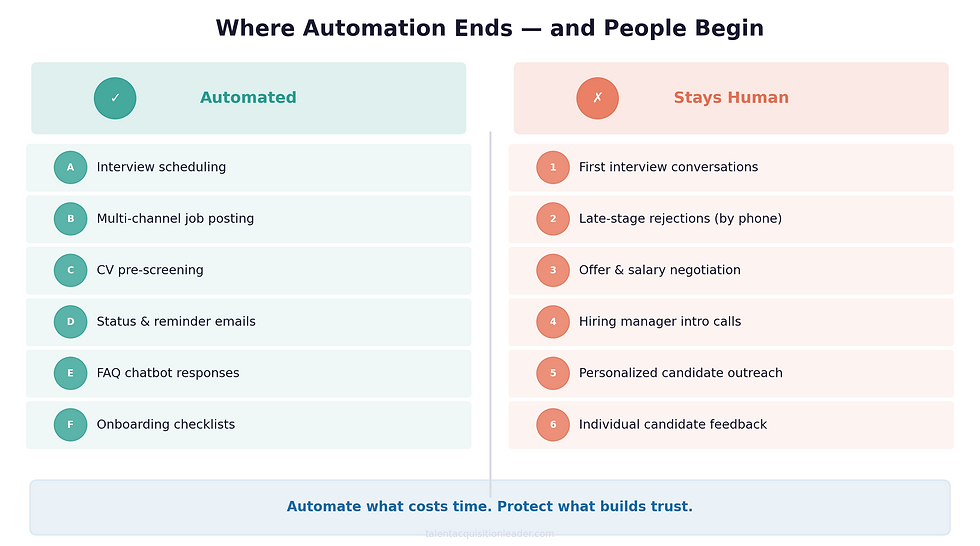
These are the tasks where automation clearly wins: interview scheduling, posting jobs across multiple channels, status emails at each process step, CV pre-screening against defined criteria, FAQ chatbots on the careers page, reminder emails before interviews, and onboarding checklists after contract signing. These tasks cost recruiters hours per week — without any meaningful impact on the quality of the candidate relationship.
Automating interview scheduling alone saves five to fifteen hours per recruiter per week, depending on company size. That's time that flows into conversations — not calendars.
High process value, but human proximity is essential → Keep it human
This is where automation does damage. Interviews: Platforms offering AI-led first conversations were widely scaled back in 2024 and 2025 following severe damage to candidate experience and legal risks. The first real conversation with a human sets the tone for everything that follows — and that tone cannot be automated.
Rejections at advanced stages of the process: An automated rejection after three rounds of interviews is one of the most effective ways to prompt a negative Glassdoor review. 70 percent of candidates expect a human point of contact at critical stages of the process. Sending them a template email is a conscious decision to choose efficiency over relationship.
Offer conversations, salary negotiation, the first conversation with the hiring manager: everything that builds trust and commitment needs humans. AI can prepare. It can summarize. It can be structured. But it cannot persuade.
The Common Mistake: Automating Where Proximity Matters
The biggest risk with recruiting automation isn't automating too little. It's automating in the wrong places.
A typical example: companies automate their entire candidate communication in the sourcing phase — using high-volume LinkedIn or email sequences that are personalized with first names but generic in content. Response rates drop. Employer brand suffers. And recruiters wonder why the sourcing channel no longer works.
The answer: candidates recognize automated outreach. 93 percent of hiring managers confirm that human judgment in recruiting remains indispensable. And Gartner shows: candidates don't just expect transparency about whether AI is being used — they also expect the ability to speak with a human at any time.
Automation that ignores this expectation creates distance. Distance costs candidates. And losing candidates is more expensive than any efficiency gain from automation.
What This Means for TA Teams in Practice
The teams getting recruiting automation right in 2026 follow a clear logic: they automate everything that costs time and creates no relationship value. And they protect everything that builds relationships — regardless of how much time it takes.
In practice, the calendar link goes out automatically. The rejection after the first CV screening goes out automatically. The reminder email before the interview goes out automatically. But the first call comes from a human. The feedback after the conversation comes from a human. The rejection after the finalist round comes from a human — ideally by phone.
This decision isn’t a matter of available technology. It’s a matter of attitude: What should recruiting achieve—process efficiency or relationship-building? The answer, of course, is both. And that’s exactly the point: Automation enables both when used in the right places. It gives recruiters back the time they need for the moments that really matter.
Automation as a Lever, Not a Replacement
Recruiting automation is not an end state. It's a tool. And like any tool, it only delivers its full value when used correctly.
The question isn't: automate — yes or no? The question is: at which point in the process am I losing time without creating relationship value? That's where automation belongs. And at which point am I creating relationship value precisely because I'm personally present? That's where a human belongs.
Organizations that implement this consistently report 31 percent shorter time-to-fill rates — with stable or improving hiring quality. The combination of automated sourcing and human-led candidate engagement outperforms both approaches on their own.
Automation wins. But only where it doesn't come at the cost of trust.
Sources
6. CareerPlug Candidate Experience Report 2025
Transparency Notice on the Use of AI
Artificial intelligence tools were used in a supporting role in the preparation of this article. They are primarily used for research and information structuring, linguistic and grammatical review, translation, and, in some cases, the creation or editing of illustrations and visual content.
The concept, substantive statements, assessments and conclusions are those of the author and reflect his personal views, professional experience and convictions. All content is reviewed editorially before publication and remains under the author’s responsibility.
Articles on this website are neither created nor published automatically by AI. Artificial intelligence is used as a supporting tool only; full editorial and substantive responsibility remains with the author.


Comments