


When the CFO asks for ROI: How to evaluate AI in recruiting in a financially credible way


AI in recruiting is currently an easy sell. Nearly every HR tech demo promises faster processes, smarter decisions, and more productive teams. The presentations look impressive. The investment requests often do too. Usually, things only become difficult afterward.
At budget review, someone asks, “And what exactly did this deliver for us?” Talent Acquisition organizations often run into trouble—not because AI solutions are ineffective, but because their impact is mismeasured or not measured at all. What’s left is a vague mix of tool costs, saved minutes, and generic statements about innovation. That may work at an HR conference, but it rarely convinces a CFO.
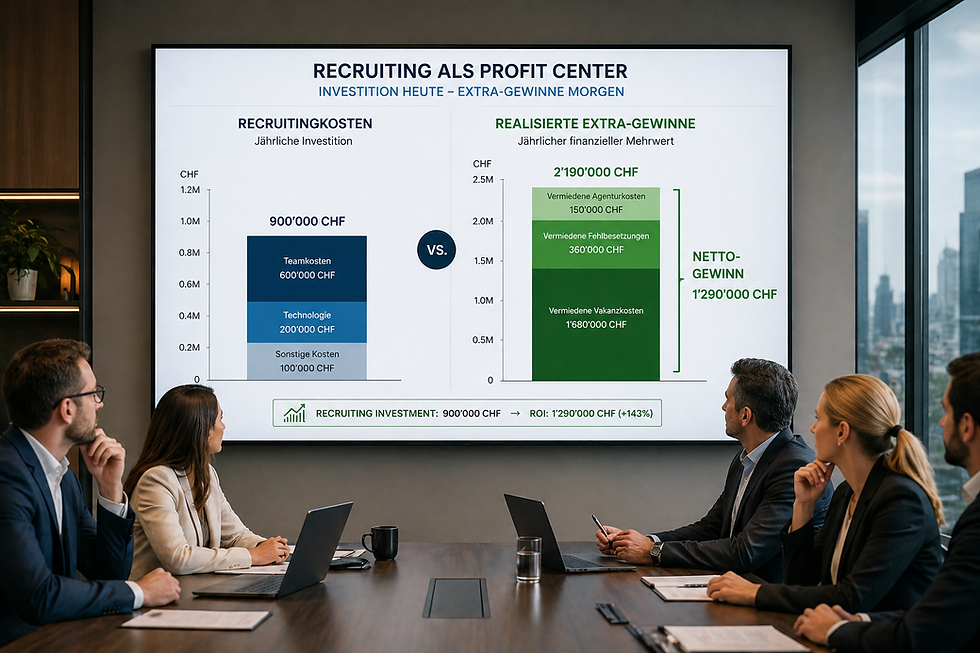
The discussion is shifting from "What can AI do?" to "What business value does AI actually create?" Amy Cappellanti-Wolf from Dayforce summarized: "This will be the year of outcomes for AI." The key is not how many AI tools a company owns, but how convincingly those tools deliver measurable business impact.
Why traditional AI ROI calculations in recruiting often fail
Many AI business cases in recruiting are still built almost entirely around time savings. At first glance, that sounds logical. If recruiters spend less time on administrative work, productivity should theoretically increase. In practice, however, this calculation is often too simplistic.
If a recruiter saves three hours per week through AI, that does not automatically create economic value. What matters is what happens with that newly available capacity. Are critical roles filled faster? Does dependency on agencies decrease? Does the candidate's experience improve? Or is the organization simply scaling an already inefficient process?
The core problem of many AI investments is that recruiting processes are interconnected. AI can dramatically accelerate individual tasks, but it can also scale poor processes efficiently. A chaotic hiring process remains chaotic, only with better automation.
This is why analysts such as Gartner and Deloitte increasingly argue that AI ROI models must be multidimensional. The real value rarely comes from a single automation. It emerges through cumulative effects across the entire Talent Acquisition architecture.
For Talent Acquisition, proving AI ROI is not about a single KPI. It's about presenting a multidimensional impact model that clearly ties AI investments to business outcomes.
The first layer: Productivity and operational efficiency
The most visible impact of AI appears at the operational level. That is exactly why many organizations focus there first. Automated interview scheduling, AI sourcing, CV parsing, or AI-supported candidate communication generate measurable effects relatively quickly. Recruiters spend less time on administrative tasks and can manage more requisitions in parallel.
These effects are real. But on their own, they are rarely enough to justify larger investments strategically. The real question is not whether recruiters work faster. The real question is whether the organization achieves better recruiting outcomes as a result.
Productivity is therefore more of an entry point than a final proof.
The second layer: Funnel and process impact
AI becomes strategically interesting when it changes process quality and funnel performance. Many AI solutions influence not only speed, but the entire candidate journey. Faster response times reduce candidate drop-offs. Intelligent job ad distribution improves qualified applicant rates. More precise matching algorithms increase the likelihood of relevant interviews.
Many organizations significantly underestimate the economic impact of unfilled roles. A critical sales position filled two weeks earlier can easily create more financial value than several hours saved by a recruiter. The same applies to production environments, engineering functions, or growth-critical tech roles.
This is when recruiting becomes relevant to the CFO: Hiring speed and quality driven by AI directly impact key business metrics. Just working efficiently isn’t enough—proving impact is essential.
The third layer: Quality of hire and retention
The most complex, but also most valuable, ROI layer lies in hiring quality. The most expensive recruiting mistakes are rarely caused by slow processes. They are caused by poor hiring decisions.
If AI:
supports more structured assessments,
reduces bias,
enables more accurate matching,
generates better shortlists,
or identifies relevant candidate signals faster,
Then the impact can directly affect retention, performance, and team stability.
The challenge is that these effects emerge over time. That is exactly why they are often excluded from ROI models altogether. Yet this is where the greatest financial leverage often lies.
Preventing a single poor senior-level hire can easily save high-five- or even six-figure costs. Compared to that, saving time on calendar coordination suddenly looks relatively insignificant.
The fourth layer: Scalability, risk, and governance
The least-discussed impact layer concerns scalability and organizational resilience. Larger organizations increasingly invest in AI to strengthen their recruiting processes. Automation reduces dependency on individuals, stabilizes global processes, and helps organizations handle hiring peaks more effectively.
At the same time, another factor will become significantly more important over the coming years: governance. With the EU AI Act, regulatory requirements for AI systems in recruiting are set to increase substantially. Transparency, explainability, human oversight, and documentation will become far more important. This also creates economic implications — both positive and negative.
Key takeaway: Strong AI governance reduces regulatory risk, adds economic value, and builds leadership confidence.

How to build a credible AI business case in Talent Acquisition
Many recruiting teams make the mistake of building unnecessarily complicated ROI models. In practice, simple and understandable frameworks often work better.
A meaningful AI business case should combine multiple impact layers, always connecting them back to business value—this sharpens the case for investment.
Typical investment categories include:
licensing costs,
implementation effort,
integrations,
training,
governance and compliance costs,
as well as ongoing optimization expenses.
In conclusion, investments must be evaluated against clear operational and business outcomes for a credible business case.
Directly measurable effects often include:
saved recruiter capacity,
reduced agency spending,
lower process costs,
faster time-to-fill,
improved funnel conversion rates,
or lower candidate drop-off rates.
The more interesting effects emerge in the medium and long term:
stronger retention,
fewer mis-hires,
faster productivity of new hires,
higher hiring quality,
or more stable team performance.
Not every effect needs to be mathematically perfect. Many HR organizations unnecessarily block themselves here. CFOs do not expect absolute precision, but logical reasoning, credible assumptions, and consistent argumentation.
Why do many TA teams sell AI internally the wrong way?
Even strong AI initiatives often fail internally because of poor communication.
Many presentations still focus on:
AI features,
tool functionality,
automation levels,
technical innovation,
or “modern recruiting experiences.”
Leadership teams care most about scalability, risk, productivity, return on capital, and predictability. Sharpen your case by speaking their language and tying AI directly to business outcomes.
Not: “Our AI copilot saves recruiters time.”
But: “We increase recruiter requisition capacity by 20 percent while simultaneously reducing external recruiting costs.”
Not: “The candidate experience improves.”
But: “We reduce candidate drop-offs during the critical interview stage by 18 percent.”
Not: “AI supports screening processes.”
But: “We reduce the average time-to-fill for critical roles by twelve days.”
This isn’t just semantic—it’s the difference between HR communication and business communication. Sharpen your impact language to sell AI’s real value.
TA leaders must prove AI ROI to secure investment.
The real shift is therefore not only about technology. It is about the role of Talent Acquisition itself.
Future TA leaders will increasingly need to:
argue economically,
develop business cases,
translate data into management language,
understand governance,
establish impact measurement,
and defend investments to CFOs and boards.
The future does not belong to the teams with the most AI tools. The future belongs to Talent Acquisition teams that credibly prove measurable business impact with AI—not just those adopting new tools.
Sources
SHRM Talent Acquisition Trends 2026
Deloitte Human Capital Trends 2026
Gartner – AI ROI in HR Research 2025
Rival HR – TA Trends April 2026
Dayforce / Amy Cappellanti-Wolf – AI Outcomes Statements
EU AI Act – Regulatory Framework for Artificial Intelligence


Comments