


Why 30 Reqs Are Not a Badge of Honor – But a Risk: How Many Open Roles Can a Recruiter Realistically Handle?

“How many requisitions (reqs, open roles) can you take on?” It sounds like an innocent question. In many organizations, however, it has quietly become a performance indicator. The recruiter carrying the highest number of reqs is seen as resilient. The one asking for relief is often – unfairly – perceived as less robust.
But recruiter load is not a character test. It is a business capacity question. And capacity can be analyzed.
The Society for Human Resource Management (SHRM) cites 15–20 active requisitions per recruiter as a realistic benchmark for complex roles. In practice – particularly in growth-driven or understaffed teams – many organizations operate at 30–50 concurrent reqs. LinkedIn, Gartner, and ERE Media regularly highlight the negative consequences of excessive recruiter load: longer time-to-hire, declining candidate experience, and increasing hiring manager dissatisfaction.
The real question, therefore, is not: How much more can we squeeze in?
It is: When does the load tip – and what happens then?

Why 30 Reqs Do Not Mean Twice the Output
Recruiting is not a linear process. Adding one more requisition does not create “a bit more work.” It adds alignment meetings, sourcing efforts, screening, interview coordination, stakeholder communication, and offer negotiations. Complexity grows disproportionately.
As load increases, predictable effects appear:
Extended time-to-hire due to unclear prioritization
Declining interview quality because briefings become superficial
Higher drop-off rates occur when candidates wait too long.
Reactive instead of strategic pipeline building
Increased errors during the offer stages
Gartner refers to this tipping point as the “capacity threshold.” Once crossed, both speed and quality decline. This can be measured through acceptance rate, hiring manager satisfaction, or candidate Net Promoter Score.
In simple terms: A recruiter managing 40 reqs rarely delivers twice the value of someone handling 20. They are simply spreading attention thinner.
A Differentiated Capacity Framework Instead of Blanket Limits
The SHRM recommendation of 15–20 requisitions is a guideline, not a law of nature. Context matters. So does role complexity.
Effective capacity planning differentiates across at least three dimensions:
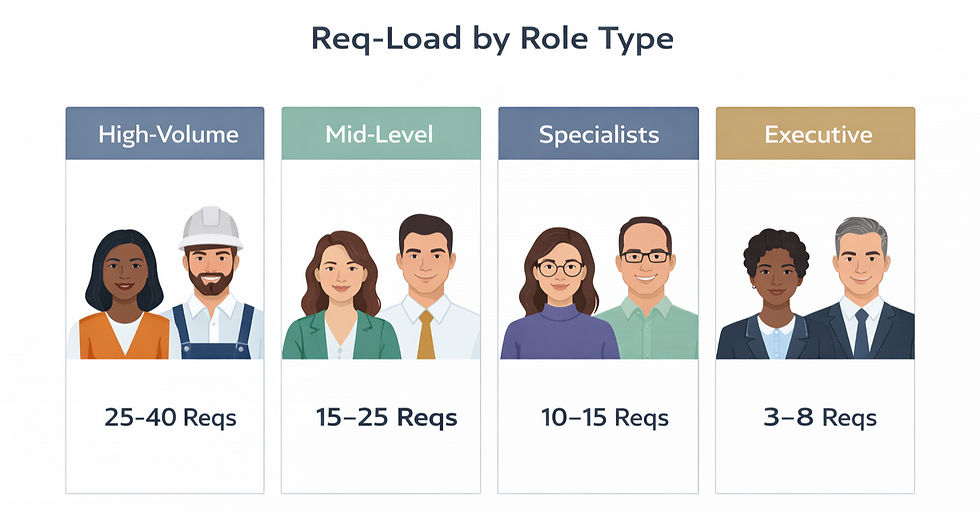
1. Role Type
Blue-collar / high-volume recruiting: 25–40 concurrent reqs possible
Mid-complexity professional roles: 15–25 reqs
Specialists / senior experts: 10–15 reqs
Executive / strategic key roles: 3–8 reqs
2. Hiring Volume per Req
One requisition may represent one hire or fifteen. Volume roles typically require less sourcing depth but more coordination.
3. Process Maturity and TA Ops (Talent Acquisition Operations)
High automation (Applicant Tracking System, scheduling tools, AI-assisted screening)
Clear service-level agreements with the business
Recruiting coordinators or sourcing support
The stronger the infrastructure, the higher the sustainable load. But technology does not eliminate structural overload. It merely shifts the tipping point.
What Happens in the Metrics When the Load Tips?
This is where the conversation becomes relevant for business leaders. Overload is not a feeling. It shows up in data.
Typical signals include:
Rising time-to-fill despite unchanged hiring priority
Declining offer acceptance rates as candidates disengage
More hiring manager escalations
Lower direct sourcing ratios and greater agency dependency
Increasing cost-per-hire despite a higher individual workload
LinkedIn’s Future of Recruiting reports consistently demonstrate that recruiting quality correlates strongly with relationship management. And relationships require time. Managing 40 parallel processes means administrating workflows, not building talent relationships.
The economic implication is straightforward:
Delayed or poor hires cost more than hiring an additional recruiter.
Shifting the Business Argument: From “Workload” to “Value Creation”
One of the most common mistakes TA leaders make is arguing emotionally: “We are overloaded.” That is understandable. But strategically weak.
A stronger argument follows economic logic:
What revenue or productivity loss results from prolonged vacancies?
How does time-to-fill change at 20 vs. 35 reqs per recruiter?
What are agency costs when internal capacity declines?
How closely does candidate experience correlate with offer acceptance?
If you can demonstrate that excessive requisition load increases time-to-fill by, say, 15–20 percent, the discussion shifts from HR sentiment to business impact.
Both Gartner and SHRM consistently emphasize workforce planning and capacity modeling as core components of strategic talent management.
Recruiting is not a fire brigade. It is a production function with a defined throughput.
A Pragmatic Capacity Calculation Model
If you want to operationalize this, use a simple formula:
Available recruiting hours per month
minus
Fixed overhead (meetings, reporting, admin)
divided by
Average time investment per requisition
Example:
160 hours per month
40 hours internal fixed commitments
120 productive recruiting hours
If a complex role requires an average of 8–10 hours of active recruiting effort per week, it becomes clear why 30 concurrent reqs are unrealistic.
Transparency creates objectivity.
Recruiter Load Is Also a Quality Question
The debate is often framed purely in quantitative terms. But this is about more than throughput.
Overloaded recruiters:
Invest less time in market analysis.
Neglect sustainable talent pools.
Conduct less structured interviews.
Document processes incompletely
Operate reactively instead of proactively.
Over time, performance suffers. So does employer brand perception. Candidate experience is not accidental. It is the result of deliberate time investment.
LinkedIn and ERE Media repeatedly note that high-performing TA teams measure not just “reqs per recruiter,” but quality of hire and stakeholder satisfaction.
A strong recruiter is not a ticketing system.
The Uncomfortable Truth
Some organizations deliberately operate at 40+ reqs per recruiter. In the short term, this reduces headcount cost. In the long term, opportunity costs rise.
Yes, there are peak phases where high load is unavoidable. The critical question is whether that peak becomes the norm.
Operating permanently beyond the capacity threshold is a conscious trade-off against recruiting quality.
And that is a conversation worth having. Clearly. And backed by data.
There is no universal answer to the question, “How many open roles can a recruiter effectively manage?” But there is a systematic one. SHRM suggests 15–20 reqs for complex roles as a guideline. Practical realities of 30–50 reqs are common, but rarely optimal.
Sustainable capacity depends on role type, hiring volume, process maturity, and strategic prioritization.
Recruiter load is not a status symbol. It is a steering instrument.
Sources
SHRM HR Benchmarks & Talent Acquisition Metrics Reports
LinkedIn Future of Recruiting 2025
Gartner Talent Acquisition Benchmarks
ERE Media Recruiting Intelligence


Comments