


From Cost-per-Apply to Real ROI – How to Steer Job Advertising Effectively

Recruiting budgets are rarely questioned at a fundamental level. Most discussions focus on the amount. More reach, more job ads, more platforms—the logic feels straightforward.
At the same time, market data paints a far more nuanced picture. Cost-per-Apply (CPA) can vary by 5 to 10 times depending on channel, role, and timing. Relying on averages in this context means steering more by instinct than by impact.
The real challenge starts beyond CPA. Applications are not an end in themselves. What matters is not volume, but contribution to successful hires. This is where traditional budget logic starts to break down. Job advertising is not media buying—it is an investment in a qualified talent pipeline. Without properly measuring this, organizations consistently optimize for the wrong outcome.
Cost-per-Apply as a false sense of precision
CPA appears precise, but is surprisingly shallow in meaning. Budget divided by number of applications—it looks clean in any report. What it lacks is relevance. The metric completely ignores whether incoming applications are actually suitable.
In practice, this leads to systematic distortion. Low-cost channels generate high volumes, but with significant noise. The reporting looks strong; operational reality does not. Recruiting teams spend more time screening, hiring managers lose patience, and processes slow down. Costs do not disappear—they shift internally.
This shift is rarely visible, but clearly felt. It shows up in longer time-to-hire, declining process quality, and a candidate experience that suffers under volume pressure. What appears to be an efficient budget allocation quietly turns into a cost driver.
The logical next step: Cost-per-Qualified-Application
If applications are the input, then qualified applications are the relevant input. The natural evolution of CPA is Cost-per-Qualified-Application (CPQA). The idea is simple: not every application counts equally—only those that meet defined minimum criteria.
The challenge lies less in calculation and more in definition. “Qualified” is not universal. It must be defined within the organization and applied consistently. Without this clarity, CPQA loses its steering value.
Common criteria that work in practice include:
Meeting clearly defined must-have requirements.
Progression into relevant funnel stages, such as an interview or a shortlist.
Positive qualitative evaluation by hiring managers.
Advancement to later-stage selection phases.
Once these criteria are clearly defined and embedded in the system, the perspective on job advertising shifts noticeably. Channels that previously looked strong on CPA lose their appeal. Others, previously considered expensive, reveal their true efficiency.
From intermediate metric to real steering model
CPQA is a major step forward—but not the final destination. The key question remains: what is the actual contribution to hires? Only when the link between budget, qualified applications, and hires is established does a true steering model emerge.
Across many organizations, a recurring pattern appears. Low CPA often correlates with weak conversion rates. Higher investment per application tends to result in more stable, predictable outcomes. The cheapest channel is rarely the most efficient.
This shifts the focus fundamentally. The priority is no longer the cost of generating applications, but performance across the entire funnel. That is where ROI is created—or lost.

Moving from static planning to dynamic steering
Another frequently underestimated factor is timing. Performance is not static. It fluctuates based on market conditions, competition, and the timing of campaigns.
These dynamics are visible in several ways:
Seasonal patterns influence both volume and quality.
Competition for specific profiles affects pricing and conversion rates.
Regional differences directly affect channel performance.
Static budget allocation ignores this reality. More advanced approaches rely on continuous optimization. Campaigns are not set once and left untouched—they are actively managed. Budgets are directed toward the channels delivering the highest impact at any given moment.
This is less about tools and more about mindset. Job advertising needs to be treated as a dynamic control system, not a one-off purchasing decision.
Connecting to business logic
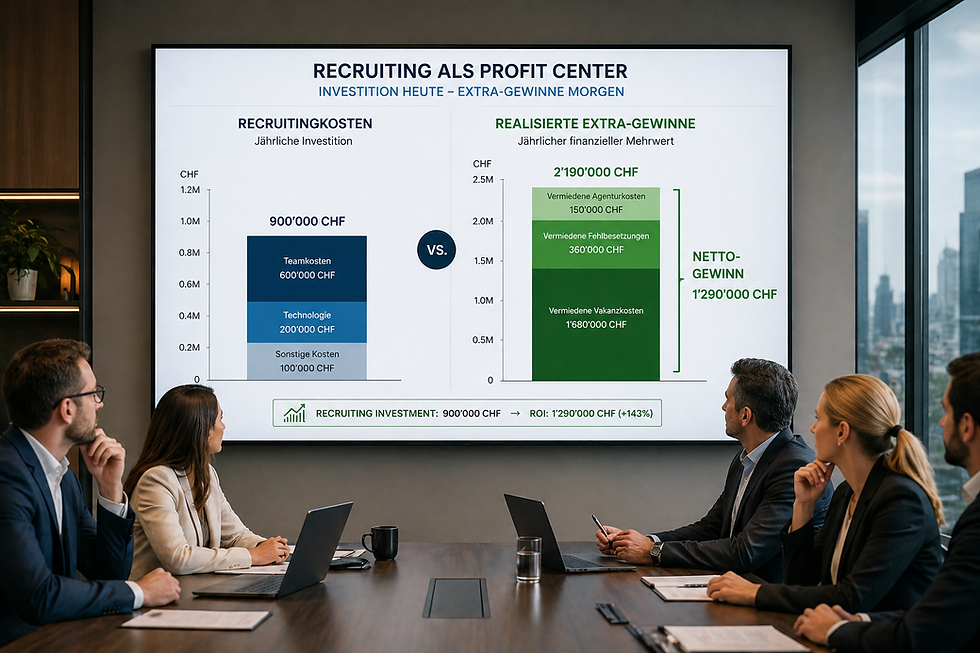
The moment of truth often comes in discussions with finance or executive leadership. At that level, arguments based on reach or application volume fall short. What matters is the contribution to business outcomes.
The conversation changes when different questions can be answered. How many hires result from a given budget? How quickly are critical roles filled? What costs are avoided by reducing vacancy time?
CPQA plays a critical role here. It translates recruiting activity into a logic that resonates beyond HR. That is precisely what makes it so valuable.
Practical implementation: start simple
At first glance, this type of steering model can seem complex. In reality, a pragmatic starting point is enough. The key is consistency, not perfection.
A workable approach includes:
Defining two to three clear quality criteria
Ensuring clean channel attribution in the applicant tracking system
Standardizing funnel stages
Running initial channel-level analysis
Gradually integrating insights into budget decisions.
With this setup, transparency increases quickly. Refinement follows over time.

Common pitfalls
Most challenges do not lie in the concept, but in execution. A few issues tend to appear repeatedly:
Overly complex or inconsistent quality definitions
Mixing fundamentally different role types in one analysis
Weak or incomplete data foundations
Overinterpreting small data samples
These are not particularly exciting problems—but they are decisive. Without a solid foundation, even the best KPIs remain ineffective.
Conclusion
Job advertising is often treated as a cost block. In reality, it is a lever for speed, quality, and ultimately business performance. Cost-per-Apply only captures the surface. Cost-per-Qualified-Application, combined with a clear funnel perspective, creates the basis for real steering.
The irony is that most organizations already have the necessary data. They simply do not use it this way. That gap represents one of the largest untapped opportunities in recruiting today.
Sources
Appcast Recruitment Marketing Benchmark Report 2025
Vonq European Job Advertising Study
StepStone Recruiting Insights / Reports 2026
LinkedIn Talent Insights / Economic Graph


Comments