


Anyone Can Recruit. Apparently, Not Everyone Can Reject.

5+1 common rejection sins in recruiting – and what they reveal about processes, culture, and professionalism

Recruiting is my field, and today I want to address a topic that genuinely annoys me: bad rejection messages. These are unnecessary, avoidable, and damaging to our profession.
Companies invest enormous effort in employer branding, career sites, social media campaigns, and glossy employer-brand videos. Yet one of the most important moments in the candidate experience still regularly fails for one extremely simple reason: rejection.
Rejections are not a side issue in recruiting. They are the norm. Statistically speaking, the vast majority of applicants will be rejected, and only a small fraction will receive an offer.
That is exactly why this moment matters so much. It shapes the impression candidates take away from an organisation—and in the worst case, the story they carry into the market.
And yet in many organisations, rejections are treated as if they were merely an administrative by-product of recruiting. A template in the Applicant Tracking System (ATS)—preferably the default one that comes with the system—one click in the workflow, done.
As a Talent Acquisition leader, a consultant in this field, and, occasionally, from the perspective of an applicant myself, I see this regularly—and it is frustrating. Not because recruiting needs to be perfect. But many of these mistakes are completely unnecessary. They are not caused by complexity. They are caused by convenience—sometimes even incompetence.
The paradox becomes even more obvious in the current labour market. In many industries, the balance of power has shifted slightly back toward employers for the moment. But demographics will push things back the other way soon enough. And when that happens, the same organisations will once again complain about talent shortages and how impossible it is to find good people.
Recruiting is not only about selection. Recruiting is also about reputation. Every candidate leaves your process with a story. The only question is which one.
To frame what follows, here is a small #FridayRant: my personal top five rejection sins in recruiting—plus one bonus category. Each reflects patterns I've seen repeatedly and provides a window into broader recruiting practices.
No. 5: The empathy-free standard rejection
You know it. Everyone knows it. “Thank you for your interest in our company. We received many strong applications and will continue the process with other candidates.”
That is it. No context. No personal reference. No sign of an actual human being.
Of course, I understand the realities of recruiting. High-volume processes require efficiency. If 300 applications come in, you cannot write 300 completely individual responses.
But there is a lot of room between “individual career coaching” and “complete emotional detachment.” A bit of creativity in wording can already make a message feel more human—and it can even reinforce your employer value proposition (EVP).
Many standard rejections sound as if they were written by a legally cautious copywriter who tried to eliminate every trace of human emotion. For candidates, it feels roughly like receiving an automatically generated parking ticket.
The problem is not efficiency. The problem is indifference.
No. 4: The standard rejection after an interview
Now it becomes uncomfortable. A candidate invests time in a screening call. Maybe even attends an in-person interview. Possibly two interview rounds. Preparation, travel, conversations—and then the exact same standard message arrives that someone receives when they simply upload a résumé.
From a candidate’s perspective, this is hard to understand. Expectations have already shifted at that point. Once an interview has taken place, people expect at least some personal feedback.
A standard rejection after an interview sends a very clear message: The process required a rejection at this stage, regardless of the person involved.
No. 3: The “we already knew this before” rejection
This variant is particularly frustrating. The candidate is rejected after several process steps because of information that was already clearly visible in the résumé.
Typical examples include a lack of language skills, limited leadership experience, or limited industry exposure. If these criteria were critical, the obvious question is: why invite the person in the first place?
For candidates, this looks like a poorly prepared process. And unfortunately, that is often exactly what it is. Hiring managers read profiles too late. Recruiters do not verify requirements consistently. The job profile changes halfway through the process. Or sometimes an excuse is simply needed because the real decision criteria were never written in the job description.
The result is equally bad for everyone involved: wasted time.
No. 2: The obvious lie
“We received a large number of highly qualified applications and will continue the process with candidates who better match the role.”
In principle, that sentence is not wrong. It becomes problematic when the same position is still actively advertised—or reappears two weeks later on LinkedIn or a job board.
Candidates monitor job postings closely. They are usually job hunting, after all. If the posting suddenly reappears, the previous rejection starts to look like a politely phrased lie.
Trust does not grow in such situations.
And trust is the most valuable currency in recruiting. Organisations that believe they can treat highly qualified talent this way will pay the price in the medium and long term.
Because companies that recruit like this often operate the same way in other areas as well.
No. 1: The rejection after three months
A personal favourite. Three months pass. Nothing happens. No update. No interim communication. And eventually a rejection arrives.
For candidates, it feels like a delayed reminder of an earlier application. There is no upper limit to how long this can take, by the way. I have heard of applications being rejected two years later—often during a large automated clean-up in the ATS.
Situations like this almost always originate from structural recruiting problems: overloaded teams, missing process discipline, or poorly configured ATS workflows. From experience, I know that something always goes wrong somewhere.
For candidates, however, that does not matter. The message remains the same:
We do not have our processes under control. You are just a data record in our system.
+1: Ghosting
Why “+1”? Because strictly speaking, it is not even a rejection—it is simply perfectly executed ignoring.
Nothing is communicated. Applicants just never hear anything again. I have even encountered well-known employers—brands that consider themselves “love brands”—who argued that they never send rejection messages because those would be bad news.
Usually, the reason is far more mundane: the application disappears somewhere in the digital chaos of the ATS. Poor processes, missing dashboards and service-level agreements (SLAs), and overwhelmed recruiters.
The problem is obvious. Candidates do not know where they stand. They wait. They might follow up. Or eventually they simply give up.
It is remarkable that such behaviour still exists in the recruiting process. In almost any other professional context, this type of communication would simply be considered rude.
Yet in recruiting, ghosting has not fully disappeared.
Why bad rejections damage your employer brand
Many companies drastically underestimate the impact of rejection messages.
The reality is simple: more people experience your recruiting through a rejection than through an offer. The rejection is therefore one of the strongest touchpoints with your employer brand.
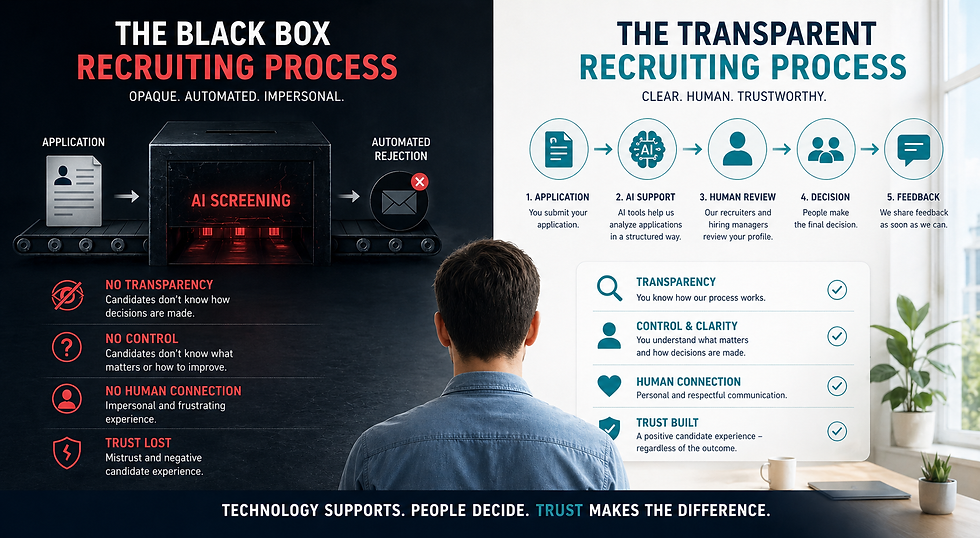
Research on the candidate experience has shown a consistent pattern over the years. Candidates evaluate organisations much more positively when they receive transparent communication and respectful rejection messages—even if they are not hired.
For example, the Candidate Experience Benchmark Report by Talent Board shows that applicants are significantly more willing to reapply or recommend an employer when they perceive the process as fair and transparent. The opposite is also true.
Negative recruiting experiences spread quickly. Platforms such as Kununu, Glassdoor, and LinkedIn make it extremely easy for candidates to share their stories publicly.
In specialised talent markets, this can become risky. Many candidates encounter the same organisations multiple times during their careers.
Recruiting is, therefore, also a form of reputation management. Act with integrity until the very end.
What good rejection management looks like
Good rejections are not rocket science. They do not require perfect wording or long feedback reports.
What they require is respect, process discipline, and the ability to communicate empathetically—while actually using the capabilities modern ATS platforms already provide.
The most important rule is simple, by far not rocket science:
The further a candidate progresses in the process, the more personal the rejection should become.
Some pragmatic guidelines from practice:
After the application is submitted, a short, personalised written rejection is sufficient.
After a screening call: an individual email or short call
After interviews: a phone call with a brief explanation
After several interview rounds, a personal conversation, and constructive feedback
“Kind regards, HR department”
Another classic in poor rejection management is the message without a real sender.
If a rejection is signed only with “HR Team” or “Recruiting Team,” it feels anonymous and impersonal. I used to tell my recruiters: If you reject someone, you should be able to sign it with your name on it. That is part of the job you are supposed to master.
A rejection should always come from a real person. It signals accountability—and incidentally shows that a human being, not an algorithm, made the decision.
“Do not reply” – heaven forbid someone asks questions.
Will candidates sometimes follow up? Of course.
But where exactly is the problem? You should be able to explain your decision. And candidate interaction should never be seen as an inconvenience by recruiters—even if conversations occasionally become challenging.
What about legal risk?
Many organisations are afraid to explain rejection decisions for fear of discrimination claims.
The concern is understandable, but often exaggerated. Problematic statements are those referring to protected characteristics such as age, gender, origin, or family status.
The reality is that discrimination does occur. It is not pleasant, but it is part of real life. Is it acceptable? Of course not. Can recruiters always prevent it entirely? Also no.
What is generally unproblematic are objective statements about role requirements—at least as long as the selected candidate actually fits the role better. It is perfectly reasonable to explain that another candidate’s experience aligns more closely with the project requirements or that they bring specific expertise in a relevant field.
The key difference lies in the reference point: the role, not the person.
A message to Recruiters: pull yourselves together and do better. It is not that difficult.
Recruiting is often described as a competition for talent. That is true. But this competition is not decided only when hiring someone. It is also decided when someone is rejected.
Every rejection is a small cultural test. It shows candidates how an organisation actually works—not on the career page, but in everyday practice. And many organisations regularly fail that test.
I can already hear the complaints when the next economic upswing arrives. But candidates will remember how they were treated.
Sources
Talent Board – Candidate Experience Benchmark Research
Greenhouse – Candidate Experience Report
StepStone Recruiting Trends
Society for Human Resource Management (SHRM) – Candidate Experience


Comments